
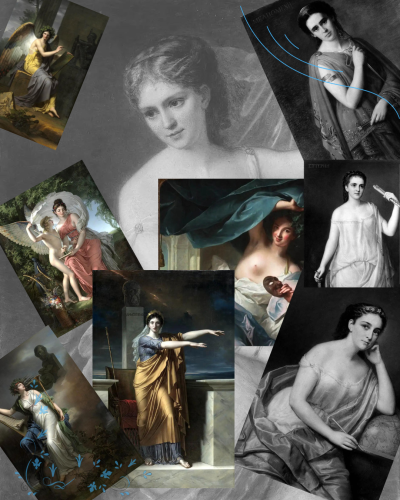
Who were the Nine Muses
Nine Muses, the daughters of Zeus and Mnemosyne, the Titaness of Memory (her name means memory from the greek word Μνήμη). The Nine Muses were: Clio, Euterpe, Thalia, Melpomene, Terpsichore, Erato, Polyhymnia, Ourania and Calliope.
The Nine Muses were believed to inspire artists, philosophers, and individuals with the necessary inspiration for creation. All the ancient writers appeal to the Muses at the beginning of their work. They lived on Mount Helicon and often accompanied the god Apollo, whose domain often overlapped with the Muses. The Muses were integral to the artistic development of ancient Greece, and poets would invoke them to help them sing, narrate a story, or remember the great stories of heroes and heroines.
The most famous Muse was Calliope, who would give the inspiration for Epic poetry, since the great Greek poet, Homer, asked for her help to narrate the adventures of Odysseus in his return to Ithaca in Odyssey and the anger of Achilles during the Trojan War.
In painting the Muses are usually presented as ethereal women with divine beauty, holding laurels and other items depending on their faculty.
Let’s meet each one of the Nine Muses:
Calliope: epic poetry
Her name means the one with the beautiful appearance from the greek words kallos (beauty) + ops (sight). Her sign is a scroll with famous poetry inscribed upon it. She was the oldest and wisest of all. Homer says to her in the beginning of Odyssey: “Tell me, O Muse, of the man of many devices, who wandered full many ways after he had sacked the sacred citadel of Troy”
Clio: history
Her name means to make someone famous/memorable from the greek word kleo (to celebrate and to make someone famous). Her sign is an open scroll or seated beside a chest of books wearing a wreath of laurel leaves. Clio could bless those she favored with historical immortality.
Erato: lyrical poetry (love poetry)
Her name means “lovely” or “beloved” from the Greek word eros (the god of love). Usually she carries a lyre. God Eros was a common accompaniment to the muse, and he gave her lots of ideas. She invented the love letters!
Euterpe: music
Her name means “the giver of delight” from the greek words eu (good) + terpo (to please). she carries the two-pipe or double-flute and the lyre. Euterpe was said to have invented the instruments, for mankind to enjoy music.
Melpomene: ancient tragedy/drama
Her name ironically means”to celebrate with song”, although ancient tragedy is about the difficulties and obstacles people suffer until they reach justice. she carries a dagger, a sword, a tragic mask, or an expression of grieving. Melpomene was also the mother of the Sirens, who drove the sailors to death .
Polyhymnia: sacred poetry and eloquence
Her name means “many praises” from the greek words polys (many) + hymnos (praise). she carries an expression of deep thinking, very serious, sometimes holding her finger infront of the mouth. Polyhymnia would guide those who wished to give eloquent speeches in the sphere of politics .
Terpsichore: dance and choral song
Her name means “delighting in dance” from the greek words terpsi (pleasure) + choros (dance). She wears a wreath of laurel leaves and dancing, sometimes she would hold lyre. Terpsichore would dance alongside Dionysus companions who would drink wine and dance frenziedly and inspire them to move their feet.
Thalia:comedy
Her name means “festivity” from the greek word thallo (to blossom). She holds a comedic mask. Thalia inspired comedy that was often a light-hearted way of introducing complicated topics to audiences
Urania: astronomy
Her name means the “heavenly one” from the greek word uranos (sky). She is depicted with a globe and a crown of stars symbolizing her influence on astronomical knowledge. Urania had the power to inspire scientific thought to help humans advance beyond their time.
Giovanna☀️